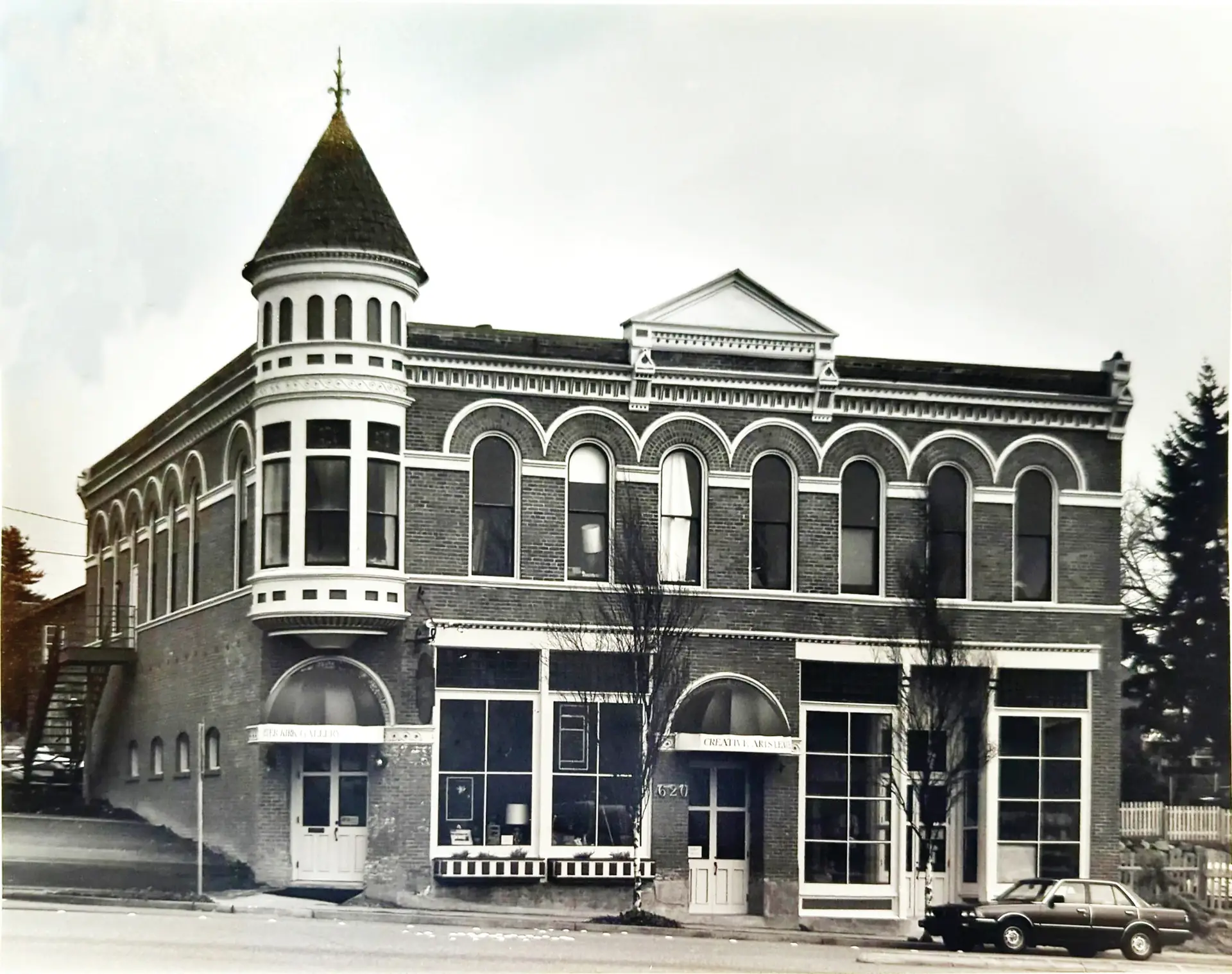
Artists and community members founded Kirkland Arts Center as the Creative Arts League in 1962. They wanted to create local opportunities in the arts while preserving an important Kirkland landmark, the Peter Kirk Building.
For more than 60 years, KAC has owned and cared for this historic building. Today, it houses an exhibition gallery, community art studios, and classrooms serving students of all ages and skill levels. The Kirkland Arts Center history reflects a longstanding commitment to creativity, education, community, and historic preservation.
Construction of the historic Peter Kirk Building began in 1890 and concluded in 1892. The building stands at the corner of Market Street and 7th Avenue, formerly known as Picadilly Street. It emerged during Kirkland’s industrial building boom of the late 19th century.
The building also represents an important connection to city founder Peter Kirk and the Kirkland Investment Company.
Peter Kirk arrived in the Seattle area in 1888 with an ambitious vision. He hoped to transform the small settlement of Kirkland into the “Pittsburgh of the West.” Kirk joined a group of Seattle businessmen to develop the Peter Kirk Building and four similar structures. Together, they hoped to establish a booming industrial town that could employ thousands of people.
The economic depression of 1893 brought those plans to a halt.
Over the following decades, a variety of businesses occupied the Peter Kirk Building, including a mercantile and drug store. The building eventually stood vacant, but its exterior remained largely unchanged.
In 1962, the Creative Arts League purchased the building and preserved it as a home for the arts. It has served generations of artists, students, instructors, and community members ever since.
The City of Kirkland Register and the National Register of Historic Places recognize the Peter Kirk Building for its historic and architectural significance. The building remains an excellent example of Victorian-era commercial architecture with Romanesque Revival elements.
Its defining features include a prominent corner turret, four double-hung windows topped with leaded stained glass, and second-story arched windows with brick headers. The building also retains its decorative cornice and historic commercial storefronts.
Peter Kirk’s local brick works produced the bricks used to construct the building. These locally made materials provide another connection between the Peter Kirk Building and Kirkland’s early industrial history.
Today, Kirkland Arts Center continues to preserve this historic landmark while filling it with art, education, exhibitions, and community. The building remains both an important part of Kirkland’s past and a vibrant part of its creative future.